

Low-Pitch Roofs (2:12 to 4:12): Materials, Underlayment and Cost
Short answer: A low-pitch roof rises about 2 to 4 inches for every 12 inches of run, roughly 9.5° to 18.4°. Under the 2025 California Residential Code, asphalt shingles are allowed from 2:12 and clay or concrete tile from 2½:12, and both need two layers of underlayment below 4:12. Under 2:12, the roof needs a low-slope membrane system instead. MDH Roofers (CA License #1067773) confirms the slope on site before writing a scope. Call (818) 350-4007.
What the Low Pitch choice means
Choose Low Pitch when the roof has a visible slope but rises gradually. Roof pitch is commonly described as the amount of vertical rise over 12 inches of horizontal run, but the calculator uses a visual choice rather than asking you to take measurements.
How a low pitch can affect roofing cost
The actual slope influences which roofing systems and installation details are appropriate. Drainage, underlayment, flashing, manufacturer requirements and transitions into steeper roof sections can all affect the scope. Existing layers, deck condition, roof area and access remain important as well.
Low-pitch roofs are not all built the same. An inspection is needed to identify the current material, confirm drainage and determine whether repairs are required beneath the visible surface.
Choose the closest illustration
Use the image as an approximation and avoid climbing onto the roof. If you are unsure, select the closest choice or use “Unknown” in the calculator. MDH Roofers can confirm the pitch during an inspection.
Which roofing materials work on a low-pitch roof?
The slope decides which roof coverings are allowed at all, before looks or budget come into it. These are the minimum slopes in the 2025 California Residential Code for the materials most Los Angeles homes use:
| Roof slope | What the code allows | Underlayment minimum |
|---|---|---|
| Under 2:12 | Low-slope systems only: built-up roofing, modified bitumen, single-ply membrane or spray foam, with a design slope of at least ¼:12 for drainage. No shingles or tile. | Set by the membrane system |
| 2:12 to under 2½:12 | Asphalt shingles. Clay and concrete tile are not allowed yet. | Two layers |
| 2½:12 to under 3:12 | Asphalt shingles, or clay and concrete tile | Two layers |
| 3:12 to under 4:12 | Also metal roof shingles, wood shingles and wood shakes | Two layers for shingles and tile |
| 4:12 and steeper | Slate is allowed from 4:12. See the medium-pitch guide. | One layer |
Source: 2025 California Residential Code, Chapter 9, Sections R905.2.2, R905.3.2, R905.4.2, R905.6.2, R905.7.2, R905.8.2, R905.9.1, R905.11.1, R905.12.1, R905.13.1 and Table R905.1.1(2). The code also requires tile and shingles to be installed to the manufacturer’s instructions, which can be stricter than the code minimum for a given product.
Why low-pitch roofs need double underlayment
Water drains more slowly off a gentle slope, so wind-driven rain has more chance to work back under shingle or tile laps. That is why the code asks for two layers of underlayment from 2:12 (shingles) or 2½:12 (tile) up to 4:12. The method is spelled out: a half-width starter strip along the eave, then full-width sheets lapped by half a sheet plus 2 inches, with 4-inch end laps offset by 6 feet. At 4:12 and steeper, one layer lapped 2 inches is the minimum.
When you compare bids for a low-pitch roof, check that the underlayment is named and that it is shown as a double layer where the slope is under 4:12. Learn more about tile roofing and asphalt shingle roofing.
Where a low-pitch roof meets a flat section
Many homes combine a sloped main roof with a flat or nearly flat area, such as a porch, an addition or a patio cover. Where tile or shingles stop and a membrane begins, the two systems need their own flashing and lapping detail, so it is one of the areas we look at closely during an inspection. Our tile roof with a low-slope section project shows one of these transitions from base sheet to finished cap sheet. For roofs under 2:12, see the flat roof guide.
Photos from MDH Roofers jobs: tile roofs meeting low-slope sections
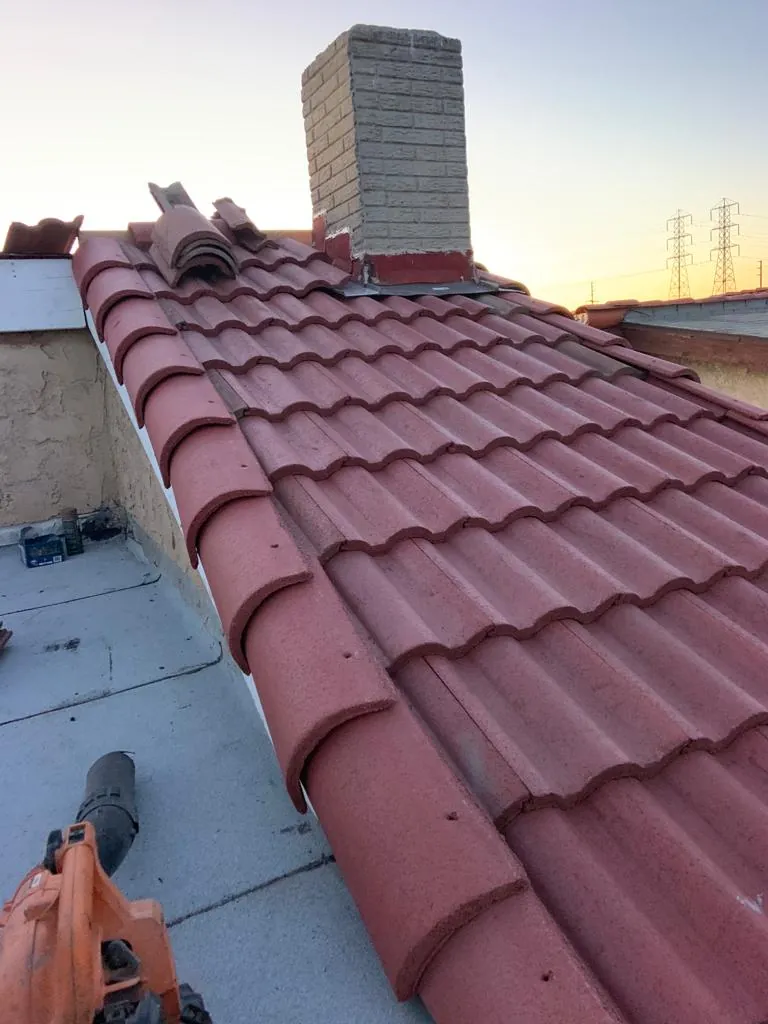


These are real MDH Roofers job photos. They show the materials and details discussed on this page, but the exact pitch of each roof was not measured for the photo, so it is not labeled.
Cool roof rules change at 2:12
Under the 2025 California Energy Code, replacing 50% or more of a home’s roof triggers cool roof requirements in some climate zones. A roof at 2:12 or steeper counts as steep-sloped. In Climate Zones 4 and 8 through 15, the new roofing must have an aged solar reflectance of at least 0.20 and a thermal emittance of at least 0.75, or a Solar Reflectance Index of at least 16, unless an exception applies, such as R-38 ceiling insulation or a qualifying attic radiant barrier. Under 2:12, the low-slope requirement is much higher, an aged solar reflectance of 0.63, and it applies in Climate Zones 4 and 6 through 15.
So a roof just under 2:12 and one just over it can face very different product rules. Measure the slope before choosing a product, and check your address with the Energy Commission’s climate zone tool.
Sources: California Energy Commission, 2025 CF1R-ALT-01-E instructions, Roof Replacement, Section 150.2(b)1I; CEC climate zone tool.
What to ask before you sign a bid for a low-pitch roof
- Is the measured slope written in the bid, and does the chosen product allow it?
- Is double underlayment included where the slope is under 4:12?
- How will the transition to any flat or steeper section be flashed?
- Does the roofing meet the cool roof rule for this address, or which exception applies?
If a low-pitch roof is already leaking, see our roof repair page. MDH Roofers is insured, offers warranties beyond a decade and answers leak calls 24 hours a day.
Questions about low-pitch roofs
Can you put tile on a 2:12 roof?
No. The 2025 California Residential Code requires a slope of at least 2½:12 for clay and concrete tile, with two layers of underlayment up to 4:12. A 2:12 roof can take asphalt shingles with double underlayment, or a low-slope membrane system.
Is a 3:12 roof a flat roof?
No. A 3:12 roof is a low-pitch roof. It is steep enough for asphalt shingles or tile with double underlayment. Roofs under 2:12 are treated as low-slope and use membrane systems such as modified bitumen or single-ply.
Does a low-pitch roof need a cool roof?
It can. When 50% or more of the roof is replaced, a roof at 2:12 or steeper must meet the steep-slope cool roof values in Climate Zones 4 and 8 through 15 unless an exception applies. Your climate zone depends on your address.
These ranges are how our guides group roofs. There is no single official definition of low, medium or high pitch, so we set the cut-offs at the slopes where California code rules change: 2:12 and 4:12 for underlayment, and 7:12 for Cal/OSHA fall protection.
Return to the Los Angeles Roof Cost Calculator
